Freitag, 22. Mai 2015

Parting from Pakxe to Kratie Cambodia

As my visa was expiring I bid a farewell to Lao following the Mekong into neighbouring Cambodia. I passed the Lao/Cambodia border at Nong Nok Khian a lonesome frontier post lost in an arid and empty landscape. Only a busload of passengers and locals on their motor carts were waiting to pass into the land of the Khmer. The procedure of getting a visa on arrival can be done either by yourself, which is rather toilsome, or doing it the easy way like I did by paying a few extra dollars, give your passport to an 'agent', stay comfortably on the bus, and after a while get your passport and visa handed over. At first glance Cambodian villages seemed less lively than those in neighbouring Lao, traffic also was less, with only very few private cars on the road. After hours rolling through an arid and empty landscape and passing dull villages we arrived at the town of Kratie which had a much more greener setting.
Kratie (or Kracheh) stretches along the east bank of the Mekong River. It has a fine riverfront and attracts a fair share of visitors, many of whom wish to catch a glimpse of the last few Irrawaddy Dolphins left in the world. The best place to see them is Kampi Village about 15 km from town. I pedalled there and had very scenic views of the river, passing rural Khmer villages, fields and shadowed back lanes. The town of Kratie offers an authentic rural ambiance, and therefore serves as the perfect place to spend a few peaceful nights. A popular end-of-the-day activity in Kratie is to relax by the riverfront and watch the sun set


Map of Cambodia showing the Mekong (Kratie is transcribed as Kracheh)


Border crossing post in the middle of nowhere between Lao and Cambodia


Oudom Sambath Hotel on the Mekong river esplanade. I spent a couple of nights there enjoying the lazy pace of this small town


Children play with a giant palm leaf in a shady back lane outside town


Khmer stone sculpture at the entrance to an old and fairly maintained temple a few steps from the riverbank

Cambodian style rolling wicker basket shop on its way to clients along the river


Moto-carts are used to haul heavy and oversize loads


A man carefully watches out for overtaking buses before crossing a narrow bridge


Kratie fairground


The river esplanade in front of my guesthouse. A very relaxing place for strolls while enjoying an evening breeze from the river and to watch the sunset


A solitary boat heads up the river at dawn


A rolling Cambodian 'department store ' with the owners taking a break in the shade of a huge tree


Typical rural homes outside Kratie. They are built on stilts and a footbridge connects to the dam road


The Mekong near the small town of Kampi some 15 km north of Kratie. It is a recommended spot to catch a glimpse of the endangered  Irrawaddy Dolphins.


A woman dressed in a  pyjamas-look-alike flowered suit very popular among ladies in Kratie sells 'bamboo rice'. Sticky rice is packed into a bamboo stem and cooked in fire


'Rush hour' on the river esplanade in Kratie


Tuk Tuk drivers are patiently waiting for passengers


Mittwoch, 20. Mai 2015

A Passage to Pakxe

My next destination was Pakxe which lies about seven hours by bus farther south of Thakek. As the road wasn't anything close to the Mekong so I could watch the river en route, I decideded for a night coach which left Thakek around 8 in the evening and arrived about 4 in the morning. The bus driver dropped me off on what he said was near downtown, and, despite the early hour several Tuk Tuk drivers were waiting for passengers. One of them took me to the guesthouse I had picked, and a sleepy clerk without opening his eyes much let me check in to get some sleep which  I needed badly after a rather uncomfortable trip without much sleep.
Pakxe is the capital of Champasak Province, and in the old days was part of the Cambodian Angkor empire. Vat Phou near the town of Champasak is the most striking relic of this time. Today Pakxe encompasses the southern Mekong region of Laos.
Pakxe retains the Mekong River-town lethargy and slightly  morbid charm found in Thakek further north but lacks the tourist infrastructure of the latter. Only few derelict colonial era buildings remain, and while I was there the whole downtown area seemed a huge building site with rubble, and open roads and sidewalks everywhere. The town itself has not many attractions but is an ideal base from where to explore the surrounding attractions like 4000 islands in the Mekong, Vat Phou and the Bolaven Plateau with its coffee and tea plantations spectacular waterfalls, minority tribes and weaving villages not to forget its beautiful rural scenery

A monk passes the old school building of Wat Luang Pakse. In the background the big new school


At Pakxe the Se Done River to the right meets the Mekong River in the background


A small market near the riverfront for the trading of livestock. These baskets hold pigs of all sizes


At the fresh market of Pakxe a wealth of local products are for sale. This woman sells mushrooms which are an essential ingredient in many Lao dishes


Fresh from the nearby farms. Poultry is an important part in many Lao dishes


Fish is of course a major source of food for the people along the Mekong. A catch is piled on the floor and sprinkled with water every once in a while


This woman prepares bark. I could not find out whether they are used for cooking or not. However, in the far North of Lao a specific bark is added to soups for a distinct flavour


A floating riverside restaurant at dawn


The Bolaven Plateau is home to numerous waterfalls, the Tad Fan waterfall being one of the most spectacular ones


A pig rifles through the grounds of Tha Taeng village. This village is home to the minority tribes of Alak, Nge and Ka Tu. Families with up to 60 members live in one house


A girls smokes her bamboo pipe. Tobacco is filled into the bowl made from an empty can that is fitted to a long bamboo stem. She was smoking constantly while I was there and no one seemed to care although she was not more than about 13 years old


A suspension bridge crosses Van Ngao River near Phasuam waterfall. Note the basalt columns that flank the river

The building of the Chinese Association of Pakxe. One of the better kept historic buildings in town


Dienstag, 19. Mai 2015

Try out Thakek

I left Vientiane on a fairly comfortable bus and for hours we rolled through flat terrain, unfortunately with only occasional sights of the river. Small and rather miserable dusty villages stretched along the road. After a couple of hours the landscape turned greener and  the outline of the rugged Khammouane Mountains appeared on the horizon.  Situated between the Mekong and the Annamite Range, the Khammouane Plateau is a very scenic mountain area featuring gorges, grottoes, jungles, sugarcone limestone hills, and rivers.  The mountains are famous for its caves and underground streams, with some of them being up to 7 km long and only accessible by boat. Many of the caves were used as shelter from bombing during the Vietnam War.
After dusk the bus arrived in Thakek. Thakek, is the sleepy provincial capital of Khammouane Province and stretches along the Mekong just opposite the Thai city of Nakhon Phanom. The small town was founded around 1911 and boasts a handful of derelict pastel villas designed in French colonial architectural style clustered around a simple town square area, a collection of colonial era shophouses and a breezy riverside position and relaxed ambiance.


French colonial architecture. A building near the riverfront downtown Thakek

 Streetside barber. The man and the boy use the hot and lazy noon hours for a quick trim


Typical shophouse of the old days on mainstreet


 A junkyard just off mainstreet with two bicycles.


Sunset over the Thai city of Nakhon Phanom on the opposite shore of the Mekong River


A small flock of goats feeds on sparse pasture above the Mekong. Goats were quite common in the outskirts of the town.


A solitary abandoned building stands on the river banks


 This cow ruminates lazily in a temple yard outside Thakek


Two school boys admire my MTB. It was the best of the many rental bicycles I used during my trips


 Lao school boys are curious. What is behind the lens ?


 Monks pedalling along the riverfront to their nearby temple


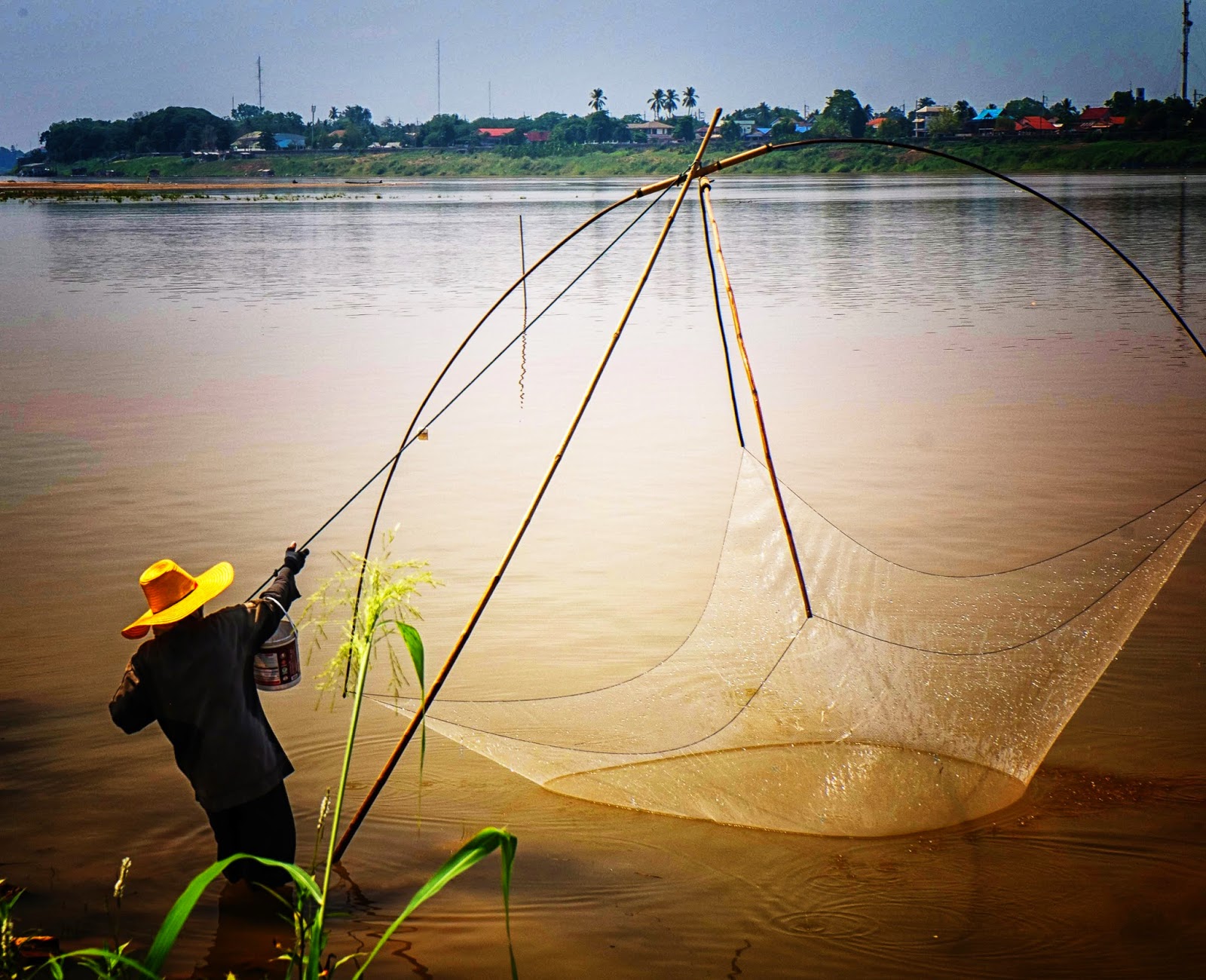
 A fisherman lifts his net out of the river while the late afternoon sun reflects on the Mekong


 This woman sells crisp Lao flatbread in the early morning hours in the streets of Thakek


The cool and sleepy ambiance under a giant Bodhi tree and a refreshing breeze from the river help to get over the hot afternoon hours


Typical dish along the Mekong. Whole fried fish in a salt crust

Sonntag, 10. Mai 2015

From Luang Prabang to Vientiane

I postponed my departure from Luang Prabang for about three times, and in the end I stayed for a whole week with the weather being nice,  a serene ambiance in the air you never want to part. Even after a week I'd have found more things to discover and to do and enjoy another nice evening out in one of the countless restaurant all over town. On my last evening young ambitious amateurs performed traditional Lao dances at the towns heritage  center just opposite my guesthouse. This was a perfect farewell to this unique place.
The next morning I boarded a Lao VIP bus at the southern bus terminal. A Lao VIP bus is not as old as ordinary buses, has overhead air inlets that sometimes work and the bus doesn't stop as often en route as ordinary buses do.
For hours the winding road leads through impressive and lonely mountain regions with remote settlements and very few small towns, then, after about five hours the scenic limestone cliffs of Kasi and Vang Vieng appear on the horizon and set a another highlight in this mountain spectacle. After leaving the higher mountains the road winds down into the vast, now dry plains of the Mekong and into the Lao capital of Vientiane.
Vientiane is still one of the more laid-back of all asian capitals , albeit changing rapidly. Chinese and Korean money helps to develop part of the embankment and turn it into shopping malls and fancy appartement blocks, Whilst the northern parts of the riverbanks still retain their rustic bygone charm with an occasional temple, quaint wooden buildings, makeshift drinking shacks and fishermen that despite the heat throw their nets into the brown and quiet waters. Cycling the  river embankment in those areas gives an idea of how life must have been in the days before big money came in.


A couple seeks the Mekong which is quite far from its former banks due to massive broadening of the original embankment. At nighttime locals use the dry river bed as trial course


Further downstream a woman pulls her net out of the brown waters of the Mekong. If there's a catch it is used by the families or sold to restaurants and foodstalls


A man uses another fishing method. While I was there he did not bring in a catch


The original embankment of the Mekong River is an unpaved lane used as a roadway. This man sits in front of a restaurant and keeps down dust whirled up by passing vehicles


A young monk sits on the embankment high above the river being deeply absorbed in typing messages into his smartphone


Around noon and with a blazing sun in the sky four fishermen stand submersed in the shallow waters of the river and wait patiently for a catch


At the 'Sputnik Burger' restaurant Vientiane you can have your meal sitting in the carcass of an old VW Beetle


Entering a Lao home or Buddhist temple never keep your footwear on


Bikers line up on the esplanade for a show off night ride